Architecture leaked into every task
Users had to translate infrastructure concepts before they could make a product decision.
02 · Real-time data streaming
One developer experience across queuing, event streaming, connectors, and stream processing.
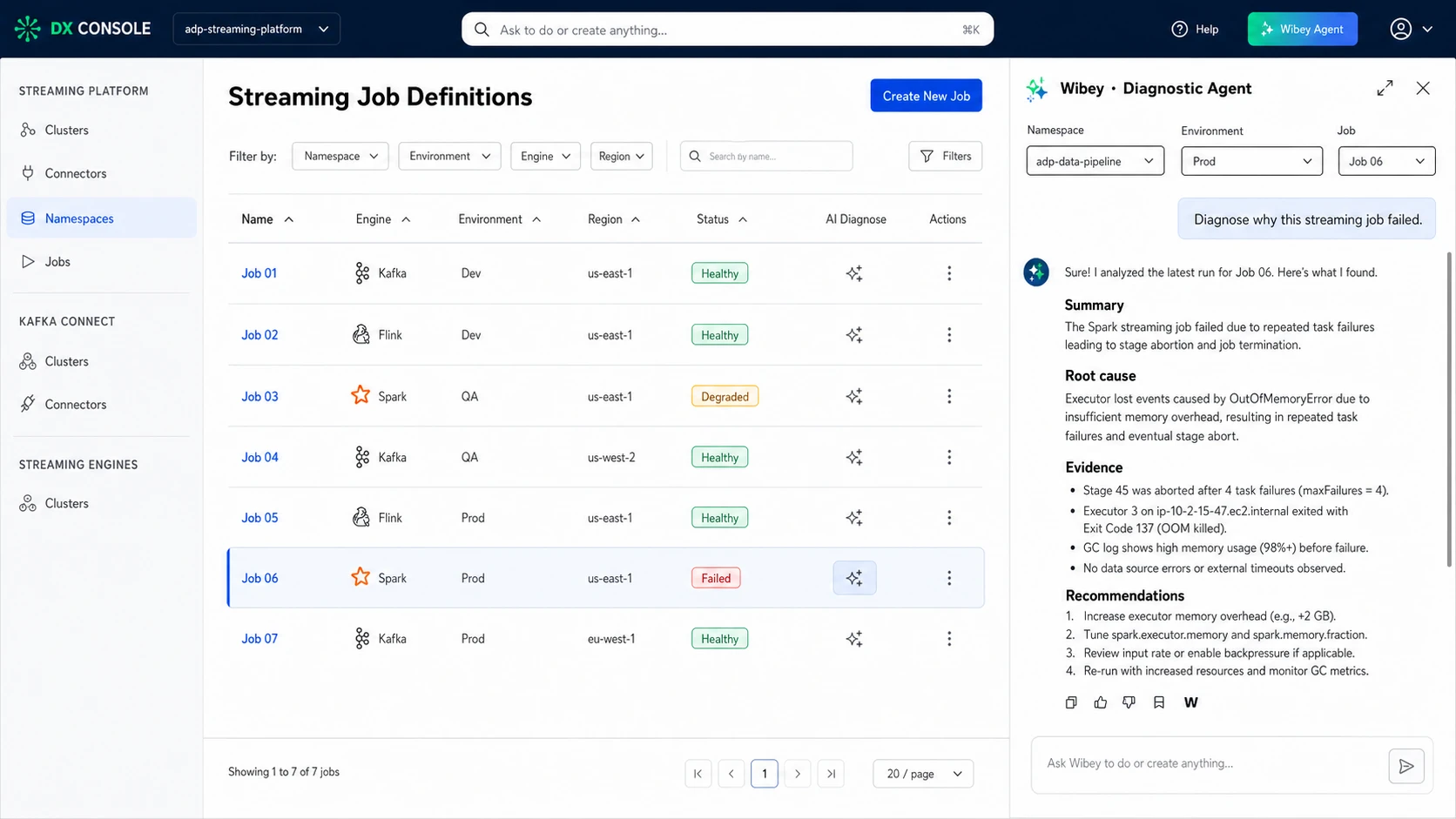
Public-safe reconstruction This visualization stays close to the authored DX shell, job list, and right-side agent interaction. Because the production interface is confidential, internal URLs, identifiers, topology, account data, and exact implementation details are replaced with synthetic content.
The product problem
The infrastructure was powerful. The product model was fragmented.
Application teams had to reason across queues, topics, subscriptions, connectors, processing jobs, schemas, retries, and ownership boundaries. I reframed separate tools as one journey: move data from a source to a trusted consumer, with operational context preserved end to end.
Users had to translate infrastructure concepts before they could make a product decision.
A configuration or schema change could affect producers, consumers, and recovery paths.
Queuing, Kafka, connectors, and processing used different structures for similar decisions.
Platform strategy
The common product language followed the data lifecycle, not the organization chart. Teams could see what produced data, how it moved, what transformed it, who consumed it, and where responsibility changed.
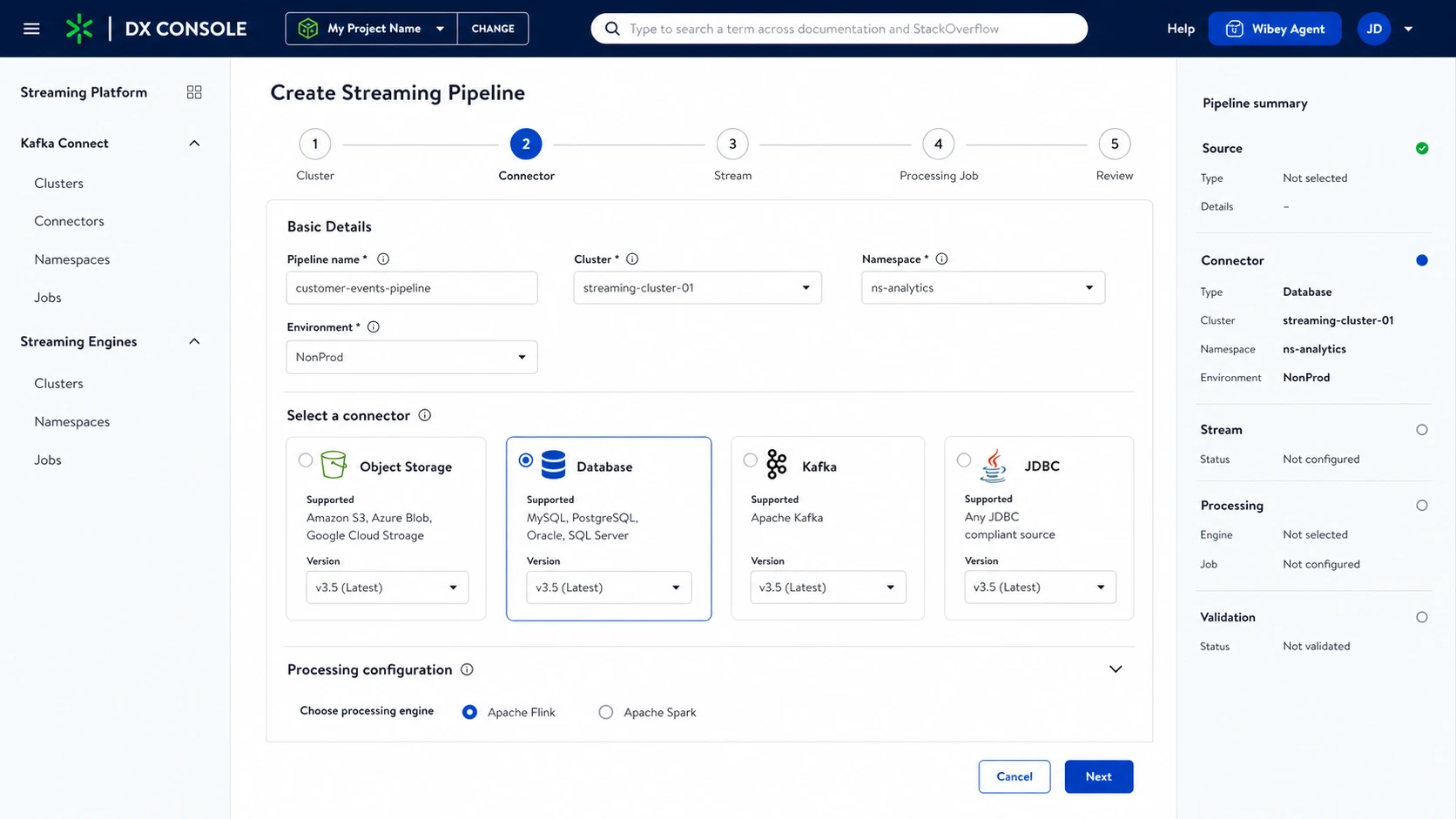
Navigation followed durable concepts such as source, stream, consumer, and job.
Ownership, schema impact, and recovery were visible before consequential changes.
Shared states and validation reduced reinvention across product teams.
Operations agent management
I explored an operations-agent layer over the platform model: interpret infrastructure, select diagnostic tools, draft constrained configurations, identify likely failure paths, and present a reviewable recovery plan.
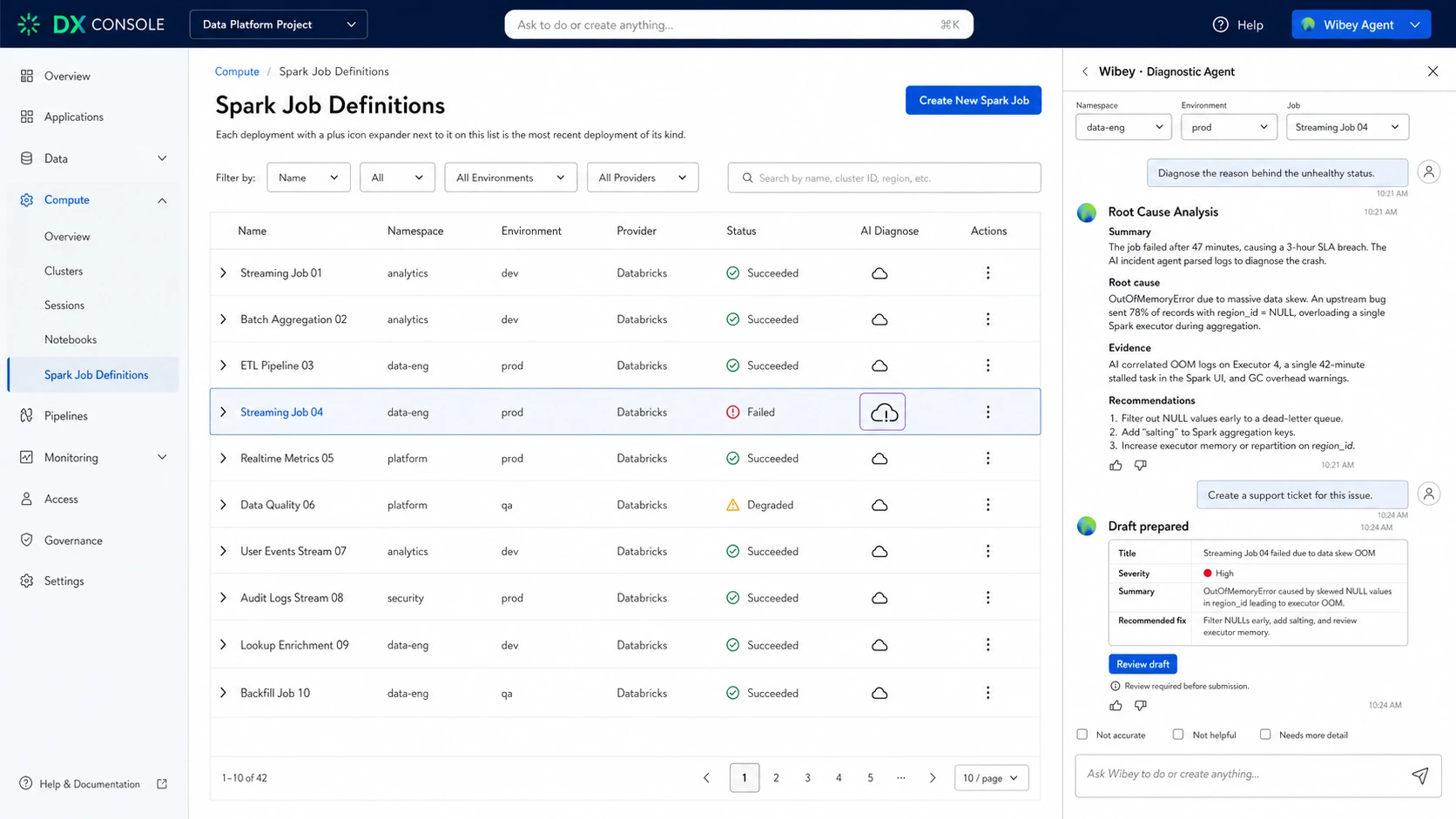
Give the agent read-only tools to summarize producers, streams, connectors, processing jobs, and consumers.
Generate a reviewable configuration plan while exposing tool inputs, schema assumptions, and dependencies.
Connect errors, retry behavior, and downstream impact to a sequenced recovery plan for operator approval.
An agent may inspect, explain, and recommend. It may not publish, delete, reroute, or change production resources without an accountable operator reviewing the plan, tools, scope, and impact.
Evidence, trade-offs, reflection
Application developers, data engineers, platform operators, and architects needed different levels of control while sharing one view of ownership, health, and downstream impact.
Working prototypes and architecture reviews made cluster, connector, job, validation, diagnosis, and recovery behavior testable before teams committed to implementation.
Hiding infrastructure made setup easier but could weaken expert control. I prioritized task language and safe defaults while preserving advanced configuration through progressive disclosure.
I would add explicit measures for setup completion, validation failure, time to diagnosis, recommendation acceptance, and recovery success before scaling agent autonomy.
Staff-level leverage
I aligned product managers, engineers, architects, and operations around shared vocabulary and lifecycle rules. Working prototypes made behavior discussable; specifications carried decisions across teams; AI-assisted design-to-code shortened the distance from design intent to a testable implementation.
Queuing, streaming, connectors, and processing became one coherent product narrative.
Define, connect, move, process, and operate organized the experience.
UX rules connected architecture decisions to implementation and review.
Next case